
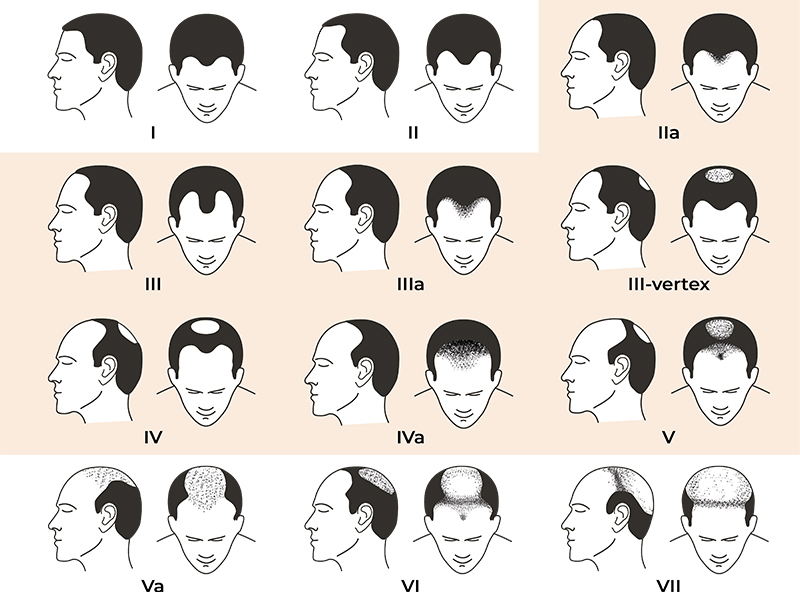
The Norwood scale is the standard classification system used to assess the progression of male pattern hair loss. It ranges from Stage 1, where there is little or no significant recession, to Stage 7, where extensive baldness has developed. For trichologists, understanding the Norwood scale provides a useful starting point for assessing hair loss, identifying its pattern and discussing appropriate management options.
Also known as the Hamilton Norwood scale, this seven stage system is widely used to describe androgenetic alopecia in men. It provides a shared reference point for individuals and professionals, helping to explain how hair loss develops and what may be expected over time. Understanding your Norwood stage can therefore play an important role in making informed decisions about hair health and treatment.
What Is the Norwood Scale in Trichology?
The Norwood scale is a visual classification system that maps the typical progression of male pattern hair loss. It was initially developed from research by Dr James Hamilton in the 1950s and later refined by Dr O’Tar Norwood in the 1970s. This is why it is also referred to as the Hamilton Norwood scale.
Male pattern hair loss generally develops in two main areas: the frontal hairline and temples, and the crown, also known as the vertex. Over time, recession and thinning in these areas can become more pronounced and eventually merge.
From a trichological perspective, the Norwood scale is useful because it helps describe the visible extent and distribution of hair loss. However, it does not establish the underlying cause by itself. A professional scalp assessment is important to distinguish androgenetic alopecia from other conditions that may cause shedding or thinning.
What Are the Seven Stages of the Norwood Scale?
The Norwood scale is divided into seven stages, representing different degrees of male pattern hair loss. A further variation, known as Type A, describes a pattern in which recession progresses from the front towards the back without a clearly defined bald spot at the crown.
| Stage | Description of Hair Loss |
| Stage 1 | Little or no significant recession. The hairline remains similar to a youthful hairline. |
| Stage 2 | Slight recession around the temples, often associated with a naturally maturing hairline. |
| Stage 3 | More noticeable recession at the temples. This is generally considered the first clearly balding stage. Stage 3 Vertex also involves thinning at the crown. |
| Stage 4 | Significant frontal recession and a visible area of crown thinning, with a band of hair remaining between them. |
| Stage 5 | The frontal and crown areas of hair loss become larger, and the band separating them becomes narrower. |
| Stage 6 | The remaining band of hair connecting the front and crown is largely lost, creating a more extensive area of baldness. |
| Stage 7 | The most advanced stage, with hair remaining mainly around the sides and back of the scalp in a horseshoe shaped pattern. |
The Type A variation follows a different progression. Rather than developing separate areas of recession at the front and crown, the hairline moves backwards more uniformly. Recognising this distinction is important when assessing the pattern and considering treatment options.
How Do Trichologists Identify Your Norwood Stage?
Identifying a Norwood stage involves examining the hairline, crown and overall distribution of hair across the scalp. Although photographs and visual comparisons can provide an initial indication, an accurate assessment requires a closer examination.
A trichologist will look beyond the visible areas of baldness to identify signs of follicular miniaturisation. This occurs when hair follicles gradually produce finer, shorter and weaker hairs, a characteristic feature of androgenetic alopecia.
The assessment may include examining the frontal hairline, checking the crown for early thinning and evaluating hair density across different areas. Trichoscopic examination can also help reveal changes in hair shaft thickness and follicular health that may not be obvious to the naked eye.
It is important to establish whether the hair loss follows a typical male pattern or whether another condition may be contributing to the problem. This distinction helps ensure that any recommendations are appropriate.
Why Does Your Norwood Stage Matter in Trichology?
Your Norwood stage provides useful information about the extent of male pattern hair loss and can help guide discussions about treatment. Generally, earlier stages offer greater opportunities to preserve existing hair, while advanced stages may require a different approach.
During Stages 1 and 2, changes may be relatively subtle. Monitoring the hairline and identifying early signs of miniaturisation can help individuals recognise progression before significant density is lost.
Stages 2 to 4 are often important periods for considering treatments that aim to slow further hair loss and preserve existing follicles. Options may include clinically established medications and suitable non surgical therapies, depending on the individual’s circumstances.
From Stages 3 to 6, hair restoration surgery may become a consideration for suitable candidates. However, the amount of available donor hair, the stability of hair loss and the individual’s expectations must all be assessed.
At Stage 7, extensive hair loss and limited donor availability can make restoration more challenging. A careful assessment is necessary to determine what results may realistically be achievable.
What Treatments Are Suitable for Each Norwood Stage?
Treatment should be based on more than the Norwood stage alone. Age, family history, rate of progression, scalp health, donor hair quality and general suitability all influence the options available.
For early and moderate male pattern hair loss, treatments such as finasteride and minoxidil may help slow progression and support hair retention or regrowth in suitable individuals. Other approaches, including platelet rich plasma therapy and low level light therapy, may also be discussed where appropriate.
For more advanced recession or crown thinning, a hair transplant may offer an option for restoring hair in areas where follicles are no longer producing visible growth. The procedure involves relocating follicles from a suitable donor area to areas affected by hair loss. The extent of coverage depends on donor supply and the size of the recipient area. Understanding how many grafts may be needed for a hair transplant is therefore an important part of treatment planning.
The International Trichology Society encourages an informed approach to hair loss management, recognising that treatment decisions should be based on individual assessment rather than a classification stage alone.
Can You Slow Progression Through the Norwood Stages?
Male pattern hair loss is generally progressive, meaning that it can become more extensive over time without appropriate management. However, progression can often be slowed, particularly when changes are recognised early.
Treatments such as finasteride and minoxidil may help preserve existing hair in suitable individuals. Professional assessment is also valuable because it can identify early follicular changes and help distinguish pattern hair loss from other scalp or hair conditions.
It is equally important to be cautious about products that promise to reverse advanced baldness. While some approaches may improve scalp condition or hair appearance, they cannot reliably restore follicles that have been permanently lost.
A hair transplant may restore hair to areas affected by advanced loss, but it does not prevent surrounding native hair from continuing to thin. Ongoing management may therefore be necessary to maintain the overall appearance of the result.
What Are the Limitations of the Norwood Scale?
Although the Norwood scale is widely recognised, it does not provide a complete picture of an individual’s hair health. It classifies the visible pattern and extent of male pattern hair loss, but several other factors are important when assessing the condition.
Diffuse thinning, for example, may affect areas across the scalp without following the typical frontal and crown pattern. This can make it difficult to assign an accurate Norwood stage.
The scale also does not measure hair shaft thickness, donor density or the contrast between hair colour and scalp. These characteristics can have a considerable influence on how noticeable hair loss appears and what restoration results may be achievable.
Another limitation is that the Norwood scale represents a snapshot of hair loss at a particular time. It does not show how quickly the condition is progressing. Tracking changes over time and assessing follicular health can therefore provide additional information that is valuable for treatment planning.
For these reasons, the Norwood scale should be viewed as a useful classification tool rather than a complete assessment. A trichological evaluation considers the individual’s overall scalp condition, hair characteristics and pattern of progression.
Frequently Asked Questions About the Norwood Scale
Here are some commonly asked questions about the Norwood scale and male pattern hair loss:
What Is the Norwood Scale Used for in Trichology?
The Norwood scale is used to classify the stages of male pattern hair loss, from minimal recession to extensive baldness. Trichologists and other hair professionals use it as a reference when discussing hair loss patterns, monitoring progression and considering suitable management options.
What Norwood Stage Is Suitable for a Hair Transplant?
Hair transplants are often considered from around Stage 3 onwards, when hair loss becomes more established. However, suitability depends on factors such as donor hair density, hair loss stability, age and individual expectations. A professional assessment is necessary before deciding whether surgery is appropriate.
Can You Reverse Male Pattern Hair Loss on the Norwood Scale?
Some early hair loss may improve with suitable treatments such as minoxidil or finasteride, although results vary between individuals. Advanced areas where follicles have been permanently lost are unlikely to regrow through medication alone. A hair transplant may be considered for suitable individuals.
How Quickly Does Male Pattern Hair Loss Progress Through the Norwood Stages?
Progression varies considerably. Some men experience gradual changes over several decades, while others develop more noticeable hair loss within a few years. Genetics, age and treatment can all influence the rate of progression.
Is the Norwood Scale Used to Assess Hair Loss in Women?
No. The Norwood scale was developed to describe the typical pattern of male hair loss. Female pattern hair loss generally follows a different distribution and is commonly assessed using the Ludwig scale or other classification systems.
Understanding Your Hair Loss Through Trichology
Understanding your Norwood stage can provide a clearer picture of male pattern hair loss and help you make more informed decisions about managing it. However, the classification is only one part of a wider assessment. Hair density, follicular health, donor availability and the rate of progression all contribute to an effective management plan.
The International Trichology Society promotes greater understanding of hair and scalp health through education and the advancement of trichological knowledge. Learning how hair loss develops and how it is assessed can help individuals approach their options with realistic expectations and a better understanding of the science behind hair restoration.


