
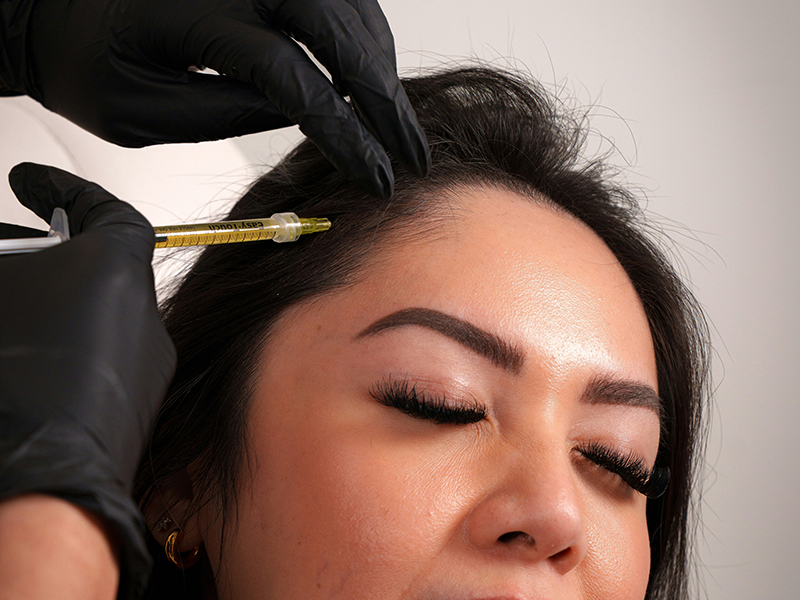
PRP hair treatment is a non surgical procedure that uses concentrated platelets from your own blood to support hair follicle activity and encourage healthier hair growth. However, understanding whether PRP is appropriate for a particular person requires more than simply understanding the treatment itself. This is where trichology plays an important role.
Trichology is the study of the hair and scalp, and a trichological approach can help assess the type, pattern and potential causes of hair loss before treatment begins. For the International Trichology Society, understanding the relationship between hair health, scalp health and treatment is central to a more informed approach to hair restoration.
What Is Trichology and PRP Hair Treatment?
PRP stands for platelet rich plasma. It is a concentrate derived from a person’s own blood that contains a higher concentration of platelets. When introduced into the scalp, the growth factors released by activated platelets may support the activity of hair follicles.
Research has investigated PRP as a treatment for different forms of hair loss, with studies reporting improvements in measures such as hair density and thickness. However, PRP is not a universal solution for every type or stage of hair loss.
This is where trichology becomes particularly relevant.
A trichological approach considers the condition of the hair and scalp before treatment. Hair loss can have many possible causes, including hereditary hair loss, changes in the hair growth cycle, nutritional factors, hormonal influences and scalp conditions. Identifying the likely cause can help determine whether PRP is an appropriate option.
The International Trichology Society promotes greater understanding of hair and scalp health, supporting an approach in which treatment decisions are based on informed assessment rather than simply treating the visible signs of hair loss.
How Trichology Supports the PRP Treatment Process
A PRP appointment typically involves taking a small blood sample, processing it to separate the platelet rich plasma and then introducing the prepared plasma into areas of the scalp affected by thinning.
The procedure itself may be relatively straightforward, but determining where and when PRP should be used requires careful consideration.
A trichological assessment can begin by examining the pattern of hair loss and the condition of the scalp. Depending on the circumstances, visual examination and magnification can provide information about hair density, hair calibre and the condition of individual follicles.
This information can help distinguish between different patterns of hair loss and establish whether the follicles are still active.
The distinction is important because PRP is generally more relevant where viable follicles remain. It cannot recreate follicles that have been completely destroyed or replace hair permanently lost from an area with no functioning follicles.
Trichology therefore helps place PRP within the wider context of hair restoration. Rather than automatically recommending injections, the focus is on understanding the individual’s hair loss and determining what approach may be most appropriate.
Who Can Benefit From a Trichological Approach to PRP?
PRP may be considered for people experiencing early or moderate hair thinning where follicles remain present but may have become miniaturised.
People with hereditary pattern hair loss may be among those considered for PRP, while other individuals experiencing diffuse thinning may also be assessed.
The important factor is not simply how much hair has been lost. The underlying cause, the condition of the follicles and the progression of the hair loss all influence whether treatment is appropriate.
A trichological assessment can also be useful for people whose hair loss has appeared suddenly. Conditions such as temporary shedding may have different underlying causes and may require a different management strategy from hereditary hair loss.
This prevents PRP from being treated as a one size fits all procedure.
Trichology can also play an important role when PRP is being considered alongside other treatments. Someone may require a combination of approaches to address both existing thinning and the progression of future hair loss.
PRP Results and the Importance of Individual Assessment
PRP does not produce immediate hair growth. Hair follicles operate according to a biological growth cycle, meaning that any changes following treatment take time to become visible.
Patients may initially experience little visible change while biological processes are taking place within the scalp. Over subsequent months, some people may notice reduced shedding or improvements in the appearance, thickness or density of their hair.
However, results vary between individuals.
This is another reason why trichology is important. A person’s response to PRP can be influenced by the type and severity of their hair loss, the condition of the follicles, their general health and the treatment protocol used.
Research has reported positive findings for PRP in hair loss, but the evidence does not mean that every patient will experience the same outcome.
A trichological assessment can therefore help establish realistic expectations before treatment. It can also provide a baseline against which changes in the hair can be monitored over time.
What Does Trichology Add to PRP Hair Treatment?
The biggest contribution of trichology is context.
PRP is one treatment option within a much broader field of hair restoration. Without understanding the cause of hair loss, it can be difficult to know whether PRP should be used on its own or alongside another treatment.
For example, medical treatments such as minoxidil may be considered for certain types of hair loss. Other patients may eventually be suitable for hair transplantation if significant permanent loss has occurred and an appropriate donor supply is available.
Scalp health may also need to be considered. If an individual has an underlying scalp condition, addressing that issue may be an important part of managing their hair before focusing on restoration.
A trichological approach therefore shifts the question from whether PRP works to whether PRP is appropriate for this particular person, at this particular stage of their hair loss.
That distinction is central to personalised hair restoration.
PRP Compared With Other Hair Loss Treatments
PRP is not the only option available to people experiencing hair thinning. Different treatments work in different ways and may be appropriate for different circumstances.
| Treatment | How It Works | Potential Role |
| PRP therapy | Uses concentrated platelets from the patient’s own blood | May support follicular activity and hair density |
| Minoxidil | Helps support hair growth and prolong the growth phase | Commonly used for certain forms of pattern hair loss |
| Finasteride | Reduces the effect of DHT on susceptible follicles | Used for certain forms of male pattern hair loss |
| Hair transplantation | Moves viable follicles from a donor area to areas of permanent loss | Suitable for selected patients with sufficient donor hair |
| Low level laser therapy | Uses low level light to stimulate cellular activity | May provide supplementary support for some patients |
The role of trichology is not necessarily to select one treatment in isolation. Instead, it can help establish which options are relevant to the individual and how they may fit together.
For some people, PRP may be the main treatment. For others, it may form part of a broader strategy alongside medical treatment or, where appropriate, hair transplantation.
Trichology, Safety and Potential Risks
PRP uses the patient’s own blood, which means concerns such as allergic reactions to an external substance are reduced. Nevertheless, PRP remains a medical procedure and should be approached with appropriate assessment and clinical care.
Temporary tenderness, soreness, bruising or mild swelling can occur around injection sites. These effects are generally temporary, but individual circumstances should always be considered before treatment.
A trichological assessment can help identify factors that may influence whether PRP is appropriate. Medical history, current treatments, scalp condition and the nature of the hair loss can all be relevant.
The key principle is that a treatment should be selected because it is appropriate for the individual’s circumstances, rather than simply because it is available.
The International Trichology Society supports greater awareness of the science behind hair and scalp health. Understanding that science can help people approach treatments such as PRP with more realistic expectations and a clearer understanding of what the procedure can and cannot achieve.
Considering PRP for hair loss? A professional assessment of your hair and scalp can help you understand the cause of your thinning and whether PRP could form a suitable part of your wider hair restoration approach.
Frequently Asked Questions
Here are some commonly asked questions about trichology and PRP hair treatment:
What is the role of trichology in PRP hair treatment?
Trichology helps assess the health of the hair and scalp and can provide insight into the possible causes and pattern of hair loss. This information can help determine whether PRP is appropriate and whether it should be combined with other treatments.
Can a trichologist tell me if PRP will work for my hair loss?
A trichological assessment can help establish whether the characteristics of your hair loss make PRP a potentially suitable option. However, no assessment can guarantee a particular treatment result because individual responses to PRP vary.
Is PRP hair treatment suitable for every type of hair loss?
No. PRP is generally considered more relevant when viable hair follicles remain, particularly in cases of early or moderate thinning. Hair loss caused by different conditions may require different forms of investigation or treatment.
Why is a trichological assessment important before PRP?
A trichological assessment can help identify the type and pattern of hair loss and assess the condition of the scalp and follicles. This can prevent PRP from being used as a generic treatment and instead place it within a personalised hair restoration plan.
Can PRP and other hair restoration treatments be combined?
Yes. Depending on the cause and progression of hair loss, PRP may form part of a broader treatment strategy. Medical treatments, scalp care and hair transplantation may all have a role in appropriate cases, with the combination determined by the individual’s circumstances.


